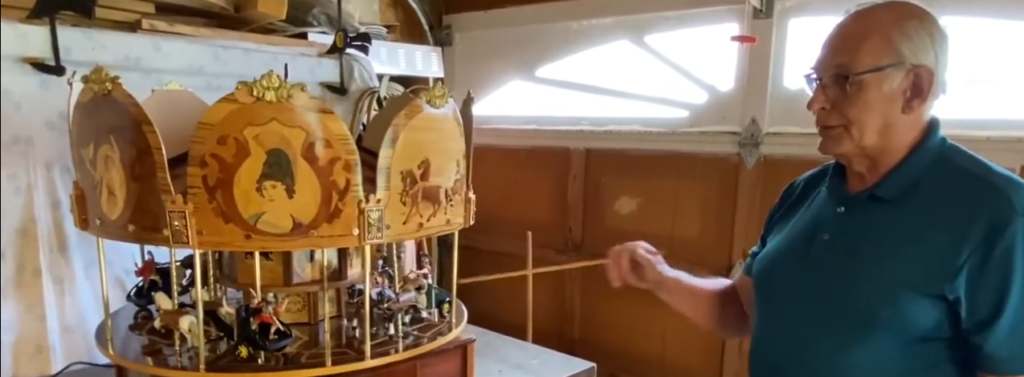
Do you have a treasured piece of furniture, box etc, that has damaged Marquetry, and your best efforts to find someone to restore it to its original condition have so far failed. That piece of history – perhaps your history, I know would welcome the opportunity to show its self again in a place of pride within your home.
I was introduced to Marquetry, in 1954 in England after receiving a hobby veneer kit as a Christmas present.From that time until now, Marquetry, or inlay as it is referred to by many people, has been my hobby; some would say my second career. This “hobby” has taken on a life of its own introducing me to the many highly talented craftsman and all aspects of fine furniture making.
Like any hobby it is necessary to be challenged, to this end I have tackled restoration projects that furniture refinishers were afraid to touch, many examples of which you can see in the gallery’s section.
My other Career has been as the President of a Manufacturing company designing automated equipment. Although unrelated, the use of AutoCAD (Computer assisted Drawing) has assisted me in the reproduction of the many damaged Marquetry patterns I have managed to restore.
I am largely self-taught; however and over many years I have gleaned from my contemporaries many new and long since forgotten techniques used by other skilled craftsmen of times gone by.
Marquetry restoration, by necessity has led me to furniture repair, refinishing techniques, such as French Polishing, wood carving, and turning as well as cabinet making. I am the past President of the Marquetry Society of Canada (marquetry society.ca), which I organized along with seven others in 1983. My work has been exhibited at jury-competitions in Canada, USA and the UK, earning many best-of-show and class award.
I have contributed to two books authored by Bill Lincoln and written articles on Marquetry for wood working magazines. Other examples of my work can be seen on the Internet or the Marquetry Society website, I have for many years given Marquetry/Parquetry courses at Lee Valley tools three Toronto stores, as well as taught summer courses at the Halliburton School of the Arts and in summer courses in West Virginia’s Roads scholar program.
Remembering a special project made for a special person.
My mother died recently, just a few days before her 94th birthday. While sifting through a lifetime of memories and birthdays, I specifically recalled her 12th birthday. No that’s not a “typo” – she was a leap-year baby – a fact she would take full advantage of in later years when asked her age.
I remembered the first time I had become really aware of the leap-year phenomenon. Her 12th birthday was a special occasion for my mother, who really was turning 48. She was just two years from an age when a woman, in polite circles, was referred to as “a woman of a certain age”. With six more months before my 14th birthday, to be such an age was inconceivable to me, as I am sure it is to all children.
For this special occasion, I decided to make something for her to use in the garden – a seat/stool/carry-all. You know the design; perhaps you still have a gnarly old one covered in paint spatters? Most everyone has seen one but cannot remember who made it. It has a hand hole in the top to carry it, with two sides about 10” to12” wide and 18” high, and a “V’ notch cutout at the bottom of both sides forming two legs.
A simple project when I think of it now, but back then I made a mistake cutting the “V” notch in one side so that it was off-center by about 1-1/2”, making one leg narrower than the other. I pondered the options and decided to ignore it. It was 1956, power tools were not part of anyone’s home workshop in England, or I suspect anywhere else. I did not relish the idea of hand-sawing another side, after all it was only for the use in the garden and I was sure my mother would not notice.
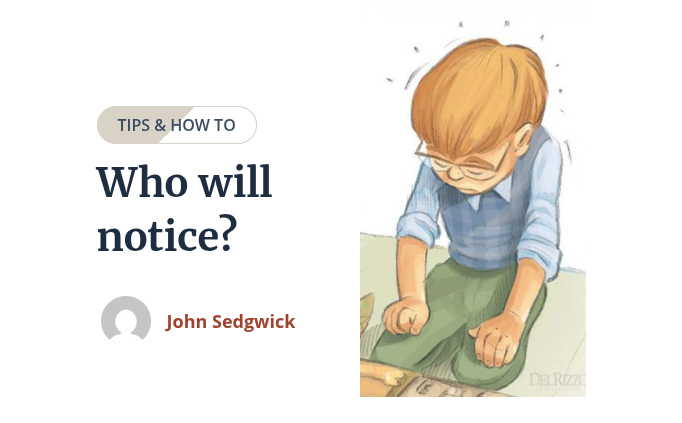
Just then my father came in and said, “What are you making, son?” I told him and he cast his eye over the pieces which I had cut and was beginning to assemble. I stood quietly and hoped he would not notice my mistake.
He paused, and as I know now, he was trying to find a way comment about the mistake without discouraging me. Without saying a word he picked up one side and laid it over the other, clearly showing the error. “It’s a great idea and looks really good, son. Your mother will love it, but if I were you I would cut another side.” I explained my reason for thinking it unnecessary and I said he noticed it because he looked closely at the pieces. “When it’s together,” I said, “no one else will notice it.” He turned to leave the workshop and as he left said, “You will, son.” He was right. My mother loved it and I am sure she never noticed the mistake. That summer she showed everyone who sat in the garden. “Bring John’s garden stool over here,” she would say as she put the tea tray on it. “You know John made this. He’s really good at wood working, just like his father. Isn’t it handy? See underneath, there is a place to put my gloves and small garden tools.”
My father was right again, I would only see the mistake and I always wondered if my mother’s friends also saw it but were just being polite when they would congratulate her on having such a clever son.
Recently I was making a drawer and I had cut the slot in the back – that holds the drawer bottom – on the wrong side. There was adequate thickness to cut another on the opposite side and no one would be able to notice the mistake. After all, it would be on the outside back of the drawer. Who, and how, would anyone ever see it? I should have known better than to think of anything else but replacing it. For many times since that day long ago – although my father is not there to see any mistakes – I can clearly hear him say, “You will, son.”